Learn how to identify limiting beliefs with a faith-anchored diagnostic process that clearly clarifies regulation, identity, and the systems shaping your daily life.

You may be doing everything that looks responsible: showing up for work, caring for your family, serving at church, paying the bills, and praying for change. Yet when an opportunity comes, something in you tightens. You delay the call, underprice the work, stay quiet in the meeting, or return to a relationship pattern you promised would end. Learning how to identify limiting beliefs begins here: not by judging the behavior, but by asking what belief makes that behavior feel necessary.
A limiting belief is not simply a negative thought. It is an internal conclusion that has become part of your operating system. It may sound like, “People like me do not get ahead,” “If I disappoint someone, I will be rejected,” or “God can use others, but not me.” These conclusions often formed when you were trying to survive, belong, or make sense of pain. They deserve honesty, not shame.
The encouraging truth is that limiting beliefs are learned, which means they can also be unlearned. The first step isn’t trying harder; it’s identifying the hidden patterns that have been quietly shaping your choices for years. When you finally see the root of the problem, you can begin to replace old beliefs with truth, renew your mind, and create lasting change through intentional action and faith.
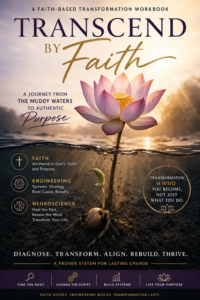
If you’re ready to stop repeating the same cycles and start building a life aligned with God’s purpose, the Transcend by Faith Transformation Blueprint Workbook will guide you through that process step by step. Inside, you’ll discover practical exercises, self-reflection prompts, faith-based guidance, and proven engineering-inspired frameworks designed to help you uncover the root causes of self-sabotage and replace them with habits that lead to lasting transformation.
What Limiting Beliefs Actually Do
Think of a belief as a hidden specification in a process. If the specification is wrong, the process can still produce a consistent result. It just will not produce the life you are praying for.
For example, someone may say they want to start a business but repeatedly avoid visibility. The surface issue looks like procrastination. The root belief may be, “If people see me fail, I will be humiliated.” Another person may overwork because rest feels unsafe. Their belief may be, “My value is earned by being needed.”
This is why motivation alone often fades. You can set a goal, buy a planner, and make a promise on Sunday night, but a belief rooted in fear will keep redirecting the system. The goal is not to force yourself harder. The goal is to find the conclusion beneath the pattern and rebuild from truth.
How to Identify Limiting Beliefs Without Shaming Yourself
The clearest evidence of a limiting belief is rarely the sentence itself. It is the repeated pattern around it. Begin with observation, like an engineer reviewing a process before changing a variable.
Notice where your life keeps narrowing
Look for areas where you repeatedly shrink, stall, overfunction, or settle. You may avoid applying for jobs even when you are qualified. You may stay hyper-independent, then resent that no one helps. You may feel called to speak, create, lead, or begin again, but every step toward it produces a reason to wait.
Ask yourself: What result keeps repeating? What do I do right before that result happens? What am I trying to prevent?
Do not rush past the last question. Self-sabotage is often self-protection that has outlived its purpose. Your nervous system may associate visibility with criticism, conflict with danger, rest with instability, or receiving help with debt. That reaction is not proof that you are weak. It is data.
Pay attention to your strongest emotional reactions
Limiting beliefs often reveal themselves through activation. A simple correction from your supervisor feels unbearable. A delayed text message creates panic. Someone else’s success makes you feel small or angry. The event matters, but the intensity may point to an older meaning attached to it.
When you feel activated, pause long enough to separate the facts from the story. The fact may be, “My manager asked me to revise this report.” The story may be, “I am incompetent, and one mistake will cost me everything.” The story is where the belief often lives.
This is not about becoming emotionally detached. It is about building regulation, so you can listen to your response without letting it run the whole system. A regulated body gives you room to choose. An activated body often reaches for familiar protection.
Listen for absolute language
Beliefs tend to use final, sweeping language: always, never, everyone, no one, cannot, too late, not enough. Write down the phrases you repeat in hard moments. “I always mess things up.” “No one stays.” “I cannot handle conflict.” “It is too late for me.”
Then ask where that statement came from. Was it spoken over you? Was it modeled in your home? Did you form it after betrayal, loss, poverty, failure, or spiritual disappointment? A belief can feel true because it has been familiar for years. Familiarity is not the same as truth.
Track the gap between what you say and what you permit
Many people can name what they want but have not yet examined what they believe they are allowed to receive. You may believe God is good in principle, yet still expect disappointment in your own life. You may encourage everyone else to take a chance while privately believing you must stay small to stay safe.
This is the identity gap. It is the distance between your stated values and the internal role you have assigned yourself. Until that role is examined, your habits will continue to protect an identity God may be calling you to release.

Diagnose the Three Gaps
At Transcend By Faith, transformation is not treated as a personality project. It is a root-cause process. Most recurring limiting beliefs are reinforced by one or more of three gaps: regulation, identity, and systems.
The regulation gap asks whether your body has enough safety to do what your mind says it wants. You may know a conversation is necessary but feel your chest tighten, your thoughts race, or your voice disappear. In that moment, forcing boldness can backfire. Start by slowing your breathing, grounding in your surroundings, and giving your body evidence that this present moment is not the old threat.
The identity gap asks who you believe you are. If you identify as the overlooked one, the fixer, the failure, or the person who must carry everyone, you will unconsciously preserve that role. Identity in Christ offers a different foundation. You are not defined by what happened to you, what you produced, or what others withheld. You are being renewed and formed in alignment with God’s design.
The systems gap asks what in your environment keeps the belief alive. A person cannot rebuild a belief about rest while maintaining a schedule with no margin, no boundaries, and no support. Someone working to overcome scarcity thinking may need a simple spending plan, clear financial data, and a practice of making decisions from reality rather than panic. Inner work needs external structure, or the old process will continue to win. Again, you can learn more about these three gaps in a workbook called “Transformation Blueprint”
Test the Belief Against Truth
Once you name a belief, do not replace it with a vague affirmation. Test it.
Write the belief plainly: “If I set a boundary, people will leave.” Then identify the evidence you use to support it. Be specific. Perhaps someone did leave when you spoke up. That pain is real. But now ask what the belief leaves out. Did everyone leave? Did their departure reveal a relationship that required your self-abandonment? Does God ask you to preserve peace by losing yourself?
Scripture does not deny suffering, but it does challenge false conclusions. Romans 12:2 speaks of renewal through a transformed mind. That renewal is not pretending a wound never happened. It is allowing God’s truth to have more authority than the survival narrative built around it.
A more truthful replacement might be: “Some people may not like my boundary, but I can be honest without abandoning love. God is with me when I choose integrity.” This is believable, grounded, and actionable. It does not promise universal approval. It returns you to alignment.
Rebuild Through Small Contradictory Evidence
A belief changes when your mind, body, and daily system receive new evidence repeatedly. If your old belief says, “My needs are a burden,” do not begin by making a dramatic demand. Start with one clear request to a safe person. Notice what happens in your body. Let yourself receive the answer without apologizing for needing it.
If the belief says, “I cannot follow through,” choose a commitment small enough to complete this week. Keep it. Record it. This is not productivity theater. It is identity evidence. You are teaching your system that you can become a person who keeps promises to yourself.
The Lotus Journey is helpful here. Mud is the painful material you did not choose. Sprout is the moment you recognize a pattern. Roots are the deeper work of regulation, truth, and support. Rise is practicing a new response when the old one feels safer. Bloom is not perfection. It is a life that increasingly reflects the person God is forming. You can read more about this in my book “Transcend By Faith”. You can pick up a copy on Amazon.
You do not have to condemn the version of you that learned to survive. But you do have responsibility for what you build next. A limiting belief is not your identity. It is a learned conclusion, and learned conclusions can be examined, grieved, and replaced. As you bring the hidden pattern into the light, you are not becoming someone else. You are making room to live as the person God intended you to be.
Rooted in Faith, Rising With Purpose.
Affiliate Disclaimer: As an affiliate, I earn commission from some of the products promoted on this website. However, this does not influence my recommendations on the products or services promoted. I only promote products that can bring value to my audience.
Disclosure: The content on my website is for informational purposes only. I am expressing my opinions of what I have experienced and what has worked for me on my personal journey. The information I write about is NOT designed to supplement or replace professional medical guidance, diagnosis, or treatment.
You should always research and seek advice from your family physician or a qualified healthcare professional for any queries about medical or mental health conditions you might have.
